Smooth Motor is specialized in high precision stepper motor and customized assembly for 32 years.
Language
Smooth Motor is specialized in high precision stepper motor and customized assembly for 32 years.
Explore our complete guide to NEMA 8 stepper motors. Discover essential sizing, specs, torque, and precision applications in medical and micro-robotics here.
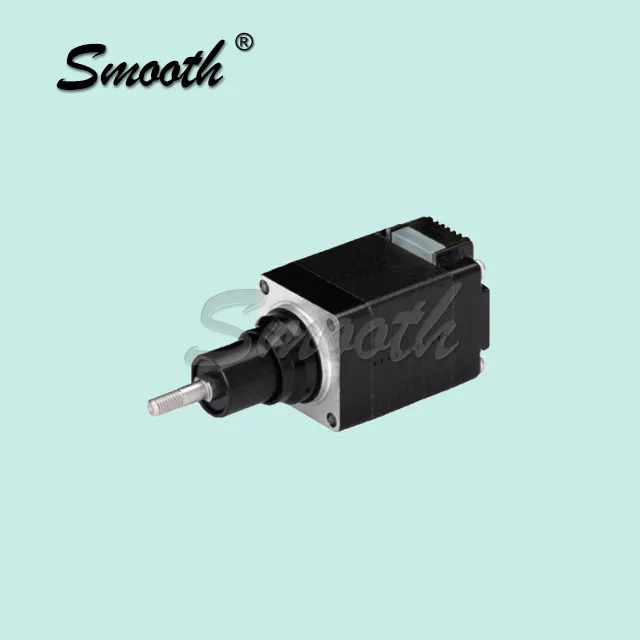
The NEMA 8 stepper motor has a faceplate of 20mm x 20mm. It's the small footprint that makes motors highly versatile. A standard hybrid version can perform 200 steps per revolution, which is 1.8-degree per step. If we hook it up with linear drives and microstepping controllers, the precise rotation translates to incredibly accurate 0.000027mm of linear movement.
Owing to their positional certainty, they are the driving force of modern medical equipment, like fluid dosing pumps and sensitive robotic tools. This article will explore this standardized equipment in detail. By the end, our readers will be equipped with an understanding of its sizing, specifications, and applications. It will empower engineers to make calculated decisions for their next precision project using a NEMA 8 stepper motor.
The name NEMA comes from the standard “National Electrical Manufacturers Association”. The number “8” simply means that the faceplate that is used for mounting is approximately 0.8 inches wide. These motors combine the hybrid stepper motor designs. They have a spinning center piece covered in tiny ridges called a multi-toothed rotor. There is a permanent magnet that locks the teeth in position, giving the motor its precision movement and torque. It consists of the following internal components:
● Stainless Steel Shaft: These are rust-resistant shafts that usually come in round, d-cut, hollow shaft, and integrated lead screw designs.
● High Grade Silicon Steel: These are layered metals to minimize heat waste through eddy currents.
● High-Quality Bearings: For smooth, low friction shaft rotations.
Motors that use two alternating electrical circuits are the most common types for the NEMA 8 size. They offer high torque at a budget friendly price. The three-phase designs use three sets of coils instead of two. It is ideal for low vibration and the reduction of humming rattle caused by the parts vibrating at their natural frequency. Let's analyze these two types of stepper motor designs:
Having three phases working together creates a more fluid motion in comparison to the larger jerky moments of two-phase motors. There are more gradual steps that make the overall operation quiet. These are vital for workplaces like science labs, where noise can impact the work process.
Two phases are ideal to lock position with a strong grip. In comparison, three phase stepper motors are much better in efficiency and maintain their torque at high RPMs.
The circuit for the two phase stepper motor is simple, and standard H-bridge controllers are enough to control it. The three-phase version needs specialized drivers to perform the complex control mechanisms.
When dealing with micro-positioning, three-phase NEMA 8s can sometimes naturally turn in tiny increments of 1.2 degrees per step angle. It gives them an inherent advantage of step resolution in comparison to 1.8 degrees of two-phase motors without the complex microstepping algorithm.
Ensuring that the motor has sufficient power to perform the targeted project intent is vital. The holding power of a NEMA 8 stepper motor is between 18 and 30 milli-Newton meters (mN.m). If we look at the curve that shows the relation between speed and torque (dynamic torque curves), we can see that motors lose their power as they start spinning faster. The sharp drop is after 400 to 500 RPM.
There is a limit to the amount of electricity that can pass through the NEMA 8 stepper motor safely. The range is 0.3 to 0.8 amperes. Pushing more electricity can make the motor overheat. The phase resistance is quite high, around 4.6 to 9.2 ohms. Fine gauge wires are compact but come with more resistance. Usually, motors have a rated voltage mentioned on their tag. Typically, engineers use 24 and 48 volts to drive the motor and force electricity through the fine gauge wires.
The limited space inside the NEMA 8 stepper motor leaves little space for heat dissipation. These motors rely on metal brackets it is bolted on to act as a heat sink. If you mount the motor with a plastic piece, your motor lifecycle may be reduced by 40%. It's best to use metal to prevent the motor from damaging itself.
The native step angle for a stepper motor is 1.8 degrees. It means that a full rotation consists of 200 individual steps. The high-resolution variants will offer 0.9 degree jumps. Which means 400 steps per revolution. These motors offer step accuracy of +-5%. If one step is slightly off, it does not add up to make the overall movement worse.
Owing to electronics, we can use microstepping drivers to artificially divide these physical jumps into even smaller steps. It can break one step into 16 or 256 micro-steps. However, the stepper motor sacrifices holding torque at intermediate positions. If motor revolutions can be slowed down using mechanical couplings, but with set gear ratios. At slow speed, the challenge shifts to overcome stiction of the bearings.
To ensure that the motor runs safely, the temperature difference between the motor and the surroundings should be below 80 C. Some motors with Class B insulation are rated for 130 C. They come with a specific heat-resistant coating that keeps the coil wires from melting and shorting. The ambient temperature suitable for their operation is between -20C to +50C. There are specific models that come with IP ratings to ensure that they are protected against water and dust ingress. Typical sealed models will offer an IP65 rating.
Selecting the right NEMA stepper motor size requires analyzing its core specifications for the application and planning for its installation. Let's break these down for your NEMA stepper motor application:
● Power: The first step is finding out how much torque is required for the application. Ensure the motor you select can handle 1.2 tor 1.3x higher torque than calculated. The factor of safety will prolong your motor life.
● Balancing: You also need to take into account the inertia of the object in comparison to the motors. The load inertia should not be more than 10 times the motor's internal shaft. Balancing the machine helps prevent resonance or missed steps.
● Size: The NEMA 8 stepper motor is the best choice when you have a small mounting footprint. They can be bolted down on a 20mm by 20mm box.
● Speed Limit: The required speed from the motor is vital. If the application requires spinning faster than 1000 RPM, then the NEMA 8 will lose too much torque. Study the torque curves closely when making purchase decisions.
● Space Management: Figure out space for the integrated electronics. Stepper motor manufacturers also have integrated motor/drive units, which can save a lot of space.
● Wiring: NEMA 8 motors are small in dimension, which makes them the top pick for engineers. However, they forget to take into account the wire routing in tight enclosures. Consider the side-exit cable space in the application. Sometimes a NEMA 11 stepper motor with a rear-exit plug may take less space then NEMA 8 with wires sticking out. Analyze your application closely.
Dimensions are key in standardized motors like NEMA 8. It is the key feature that makes them versatile and applicable across multiple applications. Let's understand what makes a NEMA 8 motor dimensionally relevant for modern projects:
● The faceplate is always a perfect 20.3mm square.
● There are mounting holes and grooves to fit threaded M2 screws.
● Raised bump in the middle of the front plate with a 15mm width.
● Length depends on torque capacity.
● Goes from 20mm basic to 48mm high torque versions
● Automated Pipettes: Exact fluid handling ● Digital Microscopes: Precise lens focusing ● Peristaltic Pumps: Steady fluid pumping ● Blood Analyzers: Compact medical testing ● DNA Sequencers: Dense genetic analysis | ● Micro-Robotic Grippers: Tiny robotic fingers ● Inspection Cameras: Precise lens aiming ● Desktop CNCs: Light automated carving ● 3D Printers: Plastic filament extrusion ● Soft Robotics: Artificial muscle pulling |
Picking a NEMA 8 stepper motor means that you have to ensure that you have the right torque requirements and space constraints figured out. The degree of precision for the application is also vital to know whether it can benefit from the micro-stepping module of the stepper motor.
These motors are ideal for micro-sized frames. It's the size that makes NEMA 8 the highly capable option for medical, robotics, and automation applications where miniaturization is key. If you project integrated precision, go for the easy to use setup offered by Smooth Motor company that offers top-tier NEMA 8 options. They offer high-precision 2, 3, and 5-phase hybrid stepper motors with hollow shaft options for wiring management. The brand offers custom assembly services with integrated leads and gearboxes. Utilize their 30 years of experience and visit the Smooth Motor website.
NEMA Size | Faceplate | Torque Range | Best For | Specific Motors |
NEMA 8 | 20mm | 0.02 to 0.05 N.m | Micro-robotics, Medical | 8HY(20 1.8°), hollow-shaft variant |
NEMA 11 | 28mm | 0.05 to 0.15 N.m | 3D Printers, Lab Gear | 11HY(28 1.8°), hollow-shaft variant |
NEMA 14 | 35mm | 0.10 to 0.30 N.m | Precision Instruments | 14HA(35 0.9°), 14HY(35 1.8°), 14HA(36 0.9°), 14HA(35 1.8°) |
NEMA 17 | 42mm | 0.30 to 0.80 N.m | Desktop CNC, DIY Robotics | 17HD(42 1.8°), 17HA(42 0.9°), 17HC(42 1.2°), 17HD hollow-shaft variant |
Q: Can I run a NEMA 8 motor at high speeds?
A: Stepper motors, especially smaller ones like the NEMA 8, lose torque rapidly as speed increases. While they can theoretically spin at 1000+ RPM, their reliable working speed is usually under 500 RPM.
Q: Why does my NEMA 8 motor get so hot?
A: Stepper motors draw full current even when stationary to maintain holding torque. This is normal, but they should be mounted to a metal surface to help dissipate heat and prevent exceeding the 80°C limit.
Q: Is a hollow shaft NEMA 8 motor less powerful?
A: Generally, no. The hollow shaft is a mechanical modification to the stainless steel shaft and does not significantly impact the magnetic flux generated by the stator and rotor teeth.
Q: Should I choose a 0.9° or 1.8° step angle?
A: Choose 0.9° if you require higher positioning resolution without microstepping. However, 1.8° motors are more common and often have slightly better torque characteristics at higher speeds.
Send Us A Message
Our extensive experience in diverse motion applications and industries, combined with our in-depth knowledge of the components used in motion control will make us an invaluable resource for your next motion control project.

