Smooth Motor is specialized in high precision stepper motor and customized assembly for 32 years.
Language
Smooth Motor is specialized in high precision stepper motor and customized assembly for 32 years.
Discover the types, uses, and working principles of stepper motors. Learn how these precise motors function and their various applications.
Ever wondered how a 3D printer or a CNC machine achieves such precise movements? It's all thanks to a little workhorse called the stepper motor. Unlike regular motors that just spin, stepper motors move in discrete steps, making them ideal for applications that need accurate positioning.
In this article, we'll explain everything you need to know about stepper motors.
Stepper motors are the unsung heroes of precision motion control. Unlike your average DC motor that just spins continuously, stepper motors move in precise, discrete steps. This makes them perfect for applications where you need accurate positioning and control, like in 3D printers, CNC machines, and robotics.
Now, let's break down the main types of stepper motors you'll encounter:
These are the most common type of stepper motor, known for their simplicity and affordability. Think of them as the "starter kit" of the stepper motor world. They have a rotor with permanent magnets and a stator with electromagnets. By energizing the stator coils in a specific sequence, you can make the rotor rotate in precise steps.
● Pros: Cost-effective, simple design, and decent step accuracy.
● Cons: Lower torque output compared to other types, and can suffer from "cogging" (a jerky motion).
VR stepper motors ditch the permanent magnets in the rotor. Instead, they rely on the magnetic attraction between the energized stator coils and the soft iron teeth on the rotor. This creates a "reluctance" (magnetic resistance) that causes the rotor to align with the energized coils.
● Pros: High-speed capabilities and excellent dynamic response.
● Cons: Lower torque output than PM or hybrid motors and can be a bit noisy.
Hybrid stepper motors combine the best of both worlds, taking elements from both PM and VR designs. They use a permanent magnet rotor and a toothed rotor to achieve higher torque, improved step accuracy, and better overall performance.
● Pros: High torque output, excellent step accuracy, and smooth operation.
● Cons: Generally more expensive than PM or VR stepper motors.
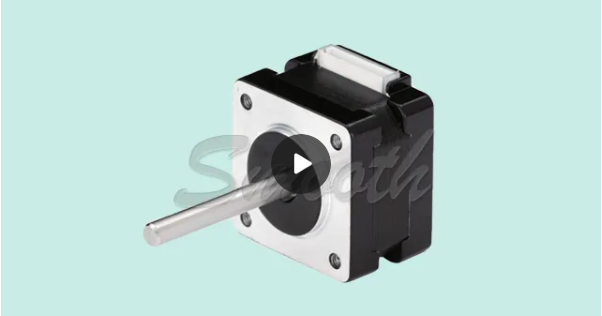
Let's break it down step-by-step (pun intended!).
At its core, a stepper motor has two main parts:
● Stator: This is the stationary outer part of the motor. It houses electromagnets arranged in phases (think of them as different groups of coils).
● Rotor: This is the rotating inner part. Depending on the type of stepper motor, it might have permanent magnets or just iron teeth.
To make the motor move, we energize the stator coils in a specific sequence. This creates a rotating magnetic field in the stator.
The rotor, with its magnets or teeth, is attracted to this rotating magnetic field. As the magnetic field rotates, the rotor follows along in discrete steps.
By carefully controlling which coils are energized and when, we can precisely control the rotor's movement. This is what allows stepper motors to achieve such accurate positioning.
Each time the magnetic field rotates, the rotor moves by a specific angle, known as the step angle. This angle is determined by the motor's design. Common step angles include 1.8 degrees and 7.5 degrees. The smaller the step angle, the finer the motor's movement.
To achieve even finer movements, we can use a technique called micro-stepping. This involves partially energizing the coils to create intermediate steps between the motor's natural step angle. Think of it like adding extra "mini-steps" for smoother, more precise motion.
Stepper motors are like the hidden gears behind many of the devices and machines we use every day. Their ability to deliver precise, controlled movements makes them essential in a wide range of applications. Let's take a look at some of the places where stepper motors truly shine:
● CNC Machines: Stepper motors are the driving force behind Computer Numerical Control (CNC) machines. They precisely control the movement of cutting tools, allowing for the creation of intricate parts with incredible accuracy.
● Robotics: From robotic arms in manufacturing plants to automated guided vehicles (AGVs) in warehouses, stepper motors provide the precise movements needed for robots to perform their tasks.
● Printing and Textile Machinery: Stepper motors control the movement of print heads in printers, the precise feeding of fabric in textile machines, and the positioning of labels on packaging lines.
● 3D Printers: Stepper motors are the heart of 3D printers, precisely controlling the movement of the extruder head to build up three-dimensional objects layer by layer.
● Cameras: They control the autofocus and zoom mechanisms in cameras, ensuring sharp images and smooth transitions.
● Gaming Machines: Stepper motors are used in arcade games, pinball machines, and slot machines to control the movement of various components.
● Automotive Gauges: Stepper motors drive the needles in speedometers, tachometers, and other dashboard gauges.
● Adaptive Headlights: They control the movement of adaptive headlights, allowing them to adjust their beam direction based on steering and road conditions.
● Medical Scanners: Stepper motors precisely position patients during medical imaging procedures like CT scans and MRIs.
● Fluid Pumps: They control the flow of fluids in medical pumps, ensuring accurate dosage delivery.
● Satellite Positioning: Stepper motors are used to position antennas and solar panels on satellites, ensuring optimal communication and power generation.
So you're ready to harness the power of stepper motors for your project. Awesome! But with so many options out there, how do you pick the perfect one? Fear not, because we're here to guide you through the selection process.
First things first, you need to figure out how much torque your motor needs. Torque is basically the rotational force the motor can deliver. Think of it as the motor's "muscle."
● Heavy lifting: If you're moving heavy loads or need high acceleration, you'll need a motor with higher torque.
● Light duty: For lighter applications, a smaller motor with lower torque will do the trick.
Pro Tip: To determine the required torque, consider factors like the load's weight, friction, and desired acceleration. You can often find torque calculators online to help you with this.
Next up, consider your speed and acceleration requirements.
● High-speed applications: If you need rapid movements, look for a motor with high-speed capabilities and good dynamic response.
● Slower, more controlled movements: For stepper motor applications that require precise positioning at lower speeds, you might not need the fastest motor on the market.
Remember the step angle we talked about earlier? This determines how finely the motor can move.
● High precision: For applications that demand high accuracy, like 3D printing or CNC machining, you'll need a motor with a small step angle (e.g., 1.8 degrees or less).
● Less critical applications: If precision isn't as crucial, a larger step angle might be sufficient.
Make sure the motor's voltage and current requirements are compatible with your power supply and driver.
● Higher voltage: Generally leads to better performance, especially at high speeds.
● Current: Affects the motor's torque output.
Consider the physical size and mounting requirements of the motor.
● Limited space: If you're working with tight constraints, you'll need a compact motor.
● Larger motors: Typically offer higher torque and power.
Think about the environment where the motor will be operating.
● Harsh conditions: If it's exposed to dust, moisture, or extreme temperatures, you might need a motor with special protection or enclosures.
We've journeyed through the world of stepper motors, exploring their types, inner workings, applications, and even how to choose the right one for your needs. These incredible devices, with their ability to deliver precise, controlled movements, play a vital role in countless industries and everyday gadgets.
From the intricate movements of a 3D printer to the precise positioning of a CNC machine, stepper motors are the unsung heroes of automation and precision control. As technology continues to advance, we can expect to see even more innovative applications for these versatile motors.
Ready to explore the world of stepper motors further? Check out our wide selection of high-quality stepper motors at https://www.smoothmotor.com/. We offer a variety of options to meet your specific needs, from compact motors for consumer electronics to powerful motors for industrial automation.
If you have any questions or need assistance in choosing the right stepper motor for your project, our team of experts is here to help. Contact us today, and let's get your project moving.
Send Us A Message
Our extensive experience in diverse motion applications and industries, combined with our in-depth knowledge of the components used in motion control will make us an invaluable resource for your next motion control project.

