Smooth Motor is specialized in high precision stepper motor and customized assembly for 32 years.
Language
Smooth Motor is specialized in high precision stepper motor and customized assembly for 32 years.
Uncover the workings of a can stack motor. Understand its unique design, advantages, and applications in various everyday devices.
Does precise motion control always mean complex or expensive? You might be surprised. Stack motors are the unsung workhorses in countless devices, offering a smart balance of performance and cost. Understanding these motors is key if you need a straightforward, budget-friendly stepping motion.
What A Can Stack Motor Is
At its core, a can stack motor is a type of stepper motor. This means it doesn't spin freely like a typical DC motor. Instead, it moves in precise, repeatable increments or steps. Think of it as turning a knob that clicks into place at set positions.
Its defining features? Simplicity and low cost. These motors are built for jobs where you need basic step control without breaking the bank. They provide a functional balance between affordability and controlled motion.
The name "can stack" comes directly from its construction. The stator (the stationary part) uses multiple C-shaped steel laminations, often covered by simple stamped metal covers that look like shallow cans. These are stacked together, hence the name. This design is much simpler to manufacture compared to other stepper types.
You typically find can stack motors in applications needing moderate accuracy and torque. They are workhorses in high-volume products where cost-effectiveness is a major design driver. We'll explore specific uses later on.
Can stack motors work using basic magnetic attraction and repulsion? The stationary part, the stator, creates magnetic fields. These fields pull and push on the rotating part, the rotor, causing it to turn in distinct steps.
The stator contains wire coils, grouped into sections called phases. Usually, there are two phases. When you send electrical current through one of these coils, it becomes an electromagnet. The "can" sections we talked about help direct this magnetic field.
The rotor inside is typically a permanent magnet. Think of it like a compass needle. It has its own fixed north and south poles, often formed into teeth around its edge. This magnet naturally wants to align itself with any magnetic field nearby.
Here's how the stepping action happens:
1. Power goes to the first phase (Coil A). This creates a magnetic field. The rotor instantly snaps into alignment with this field. It's taken one step.
2. Now, we turn off Coil A and turn on the second phase (Coil B). Coil B creates a magnetic field in a slightly different position.
3. The rotor magnet is pulled again, rotating a small, fixed amount to line up with Coil B's field. That's the next step.
4. By switching the power between Coil A and Coil B, and reversing the current direction in them, we create a sequence of magnetic fields. The rotor follows this sequence, turning step by step.
The physical design – the number of stator poles created by the cans and the number of magnetic poles on the rotor – determines the step angle. This is how far the rotor turns with each electrical pulse. Common step angles for can stack motors are 7.5 or 15 degrees. This defines the motor's resolution, or how fine its movements can be.
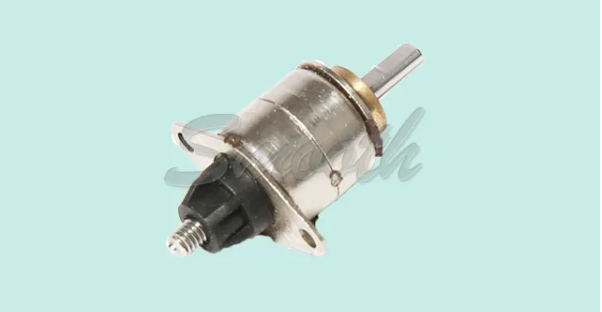
You won't find many complex pieces here. The main parts are the stator, the rotor, bearings, and the outer case or housing. Simplicity is the name of the game.
The stator holds the electrical coils. These are usually wound on simple plastic bobbins. Around these coils, thin, C-shaped metal stampings are stacked – these are the "cans" or laminations. They create the magnetic poles that interact with the rotor. Often, these are arranged into two separate phases.
The rotor is the part that spins. In a can stack stepper motor, it's typically a relatively low-cost permanent magnet, often made from ferrite material. It’s shaped like a cylinder and magnetized to have multiple north and south poles along its length. The output shaft is fixed to the center of this magnet.
To allow the rotor to spin smoothly, simple bearings are used. These are most often basic sleeve bearings (like bronze bushings) – another cost-saving measure. They support the rotor shaft at each end. The housing simply holds the stator assembly and the bearings in place, enclosing the motor.
Here's a quick rundown of the core components:
● Stator: Contains coils and stacked "can" laminations forming magnetic poles.
● Rotor: A permanent magnet (often ferrite) with multiple poles and an attached shaft.
● Coils: Wire windings that create magnetic fields when powered (usually two phases).
● Bearings: Simple sleeve bearings supporting the shaft.
● Housing: The outer structure holding everything together.
Assembly involves stacking the stator components, inserting the rotor, and securing it with the bearings and end caps. This design keeps manufacturing costs down.
Like any technology, can stack stepper motors come with their own set of pluses and minuses?
Advantages:
● Low Cost: This is their biggest selling point. Their simple design using stamped metal parts and straightforward assembly makes them very inexpensive to produce, especially in large quantities.
● Design Simplicity: Fewer components generally mean easier integration into products and potentially fewer points of failure compared to more intricate designs.
● Good Lifespan: Because they are brushless (like all steppers), there are no brushes to wear out. This gives them a solid operational life compared to many low-cost brushed DC motors.
● Basic Step Control: They offer the standard stepper benefit of holding position when stopped (called detent torque) and allow for open-loop control – you tell them where to step without needing sensors to check position for many tasks.
Disadvantages:
● Lower Resolution: Their typical step angles (like 7.5 or 15 degrees) are quite large compared to hybrid steppers (which often offer 1.8 degrees or less). This means their movement is less smooth and positioning is less precise.
● Limited Torque Output: Can stack linear actuators generally produce less torque (turning force) for their size and weight compared to other stepper types like hybrids. They aren't suited for moving heavy loads.
● Potential for Noise/Vibration: The discrete stepping motion, combined with their simple construction, can sometimes lead to noticeable vibration or audible noise, particularly at certain speeds (resonance points).
● Moderate Efficiency: They aren't always the most power-efficient option. Some energy gets lost as heat due to their basic design.
So, the trade-off is clear. You get a very affordable motor with decent life and simple control, but you give up fine precision, high power, and potentially quiet operation. It's about matching the motor's capabilities to the application's real needs.
So, there you have it. Stack motors are the workhorses for cost-effective, straightforward stepping motion. They prove that you don't always need complex engineering for basic positioning tasks. You find them hidden inside countless everyday devices for good reason.
They offer a clear trade-off: you gain significant cost savings and design simplicity. You accept lower resolution and torque compared to more advanced steppers. Understanding this balance helps you select the right motor for your specific needs and budget.
When your project calls for reliable motion control that respects your budget, exploring proven options is smart. For dependable motor solutions tailored to various applications, see what Smooth Motor offers at https://www.smoothmotor.com/.
Send Us A Message
Our extensive experience in diverse motion applications and industries, combined with our in-depth knowledge of the components used in motion control will make us an invaluable resource for your next motion control project.

